
Same-colour slot symbols need not be the same paytable symbol
Published — UTC

Several red symbols can belong to different paytable entries. Colour is a visual property; it is not automatically the identity used to count a matching combination.
Four red images, three symbol identities
Assume an invented rule pays at least three identical symbols within a stated area. Its legend distinguishes Ruby, Cherry and Heart, even though all three designs are red.
| Symbol identity | Colour | Count in the example |
|---|---|---|
| Ruby | Red | 2 |
| Cherry | Red | 1 |
| Heart | Red | 1 |
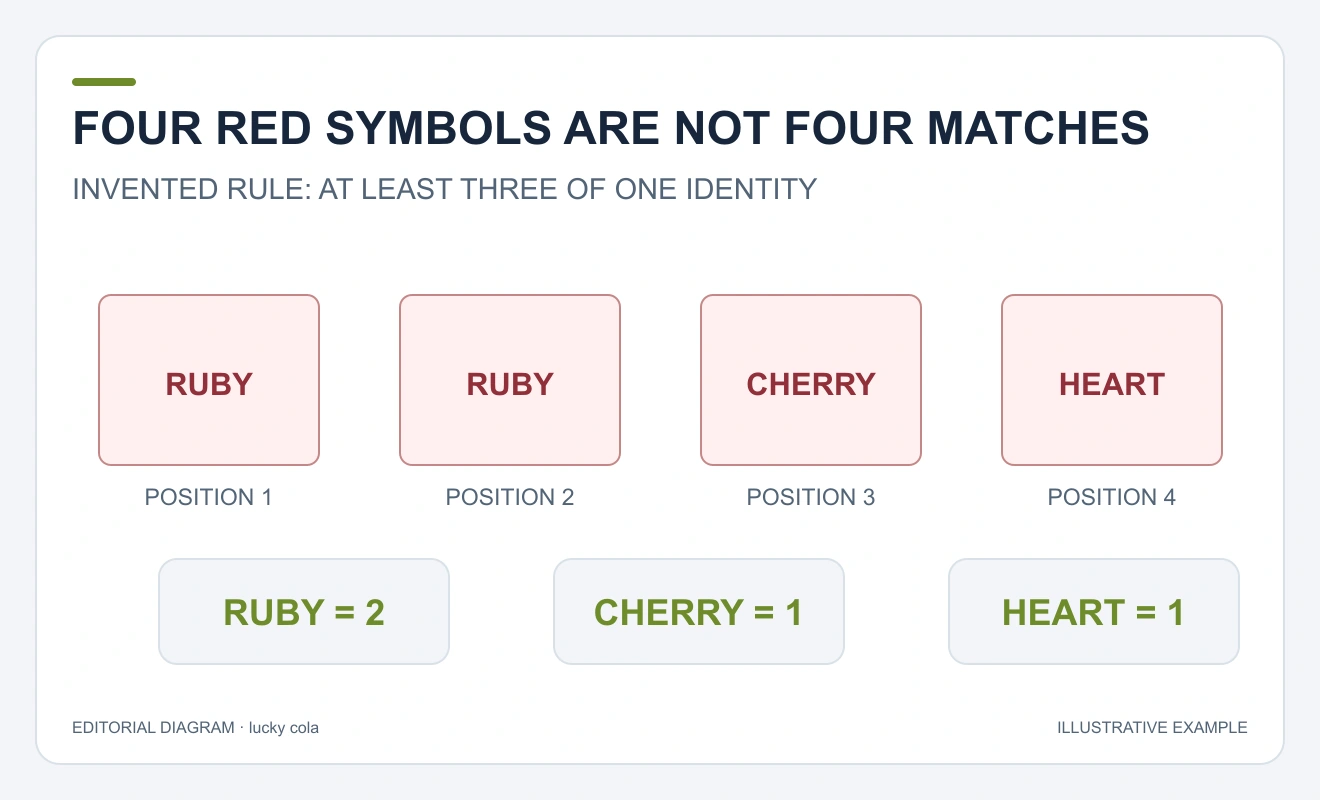
The red-image total is four, but no identity reaches three. The invented matching condition fails. A different rule explicitly accepting any red symbol would need a separate test; it cannot be inferred from the artwork.
Preserve the legend and any substitution rule
A Wild may substitute for some identities but not others. Apply only the documented rule after identifying the original symbols. A familiar design or matching colour cannot supply a missing substitution exception.
The British result-determination reference provides rule-bound context. The legend here is an original illustration and not a real edition’s paytable.
A small transcription check
Record symbol name or ID, position and current mode. Count identities first, then test required arrangement and award scope. If the legend is unavailable, describe the visible colour without claiming a verified winning group.
Count a position, not the objects drawn inside it
The Cherry icon in the cover contains two cherries on one stem, but occupies one symbol position. In this example it contributes one Cherry symbol, not two. The two separate Ruby positions contribute two Ruby symbols. Counting fruit inside the artwork would use a different unit from the paytable.
State a Wild alternative as a new case
Replace the Heart with one Wild and explicitly add a rule that this Wild may substitute for Ruby in the same eligible area. The candidate Ruby count can then reach 2 + 1 = 3, while the original observed identities remain Ruby, Ruby, Cherry, Wild. Record the observed layout first and the permitted substitution separately.
If the documented rule excludes Ruby, excludes that mode or does not permit substitution in this area, the same Wild does not establish a third Ruby. A Scatter can also have a separate counting or award rule. Neither a special symbol’s name nor its colour establishes which exceptions apply.
Identity is only the first test
Even three identical symbols might fail a rule requiring adjacent positions on a particular payline. Conversely, a count-anywhere rule can use a different eligible area. Keep the coordinates and mode with each identified symbol, then test the actual arrangement. Do not carry symbols from an earlier cascade into a later grid unless the documented feature explicitly accumulates them.
Keep ambiguity visible in a screenshot review
A crop can hide the legend, reel boundaries or a mode indicator; colour changes can also be an animation effect. Label an unreadable symbol “unresolved” rather than assigning it to the largest matching group. A useful record retains the full frame, the legend or rule version and a position-by-position transcription. The illustrative failed match here supports careful reading, not a claim about any site’s actual payout behaviour.