
Slot multipliers: when multiplying the total matches multiplying each award
Applying one identical multiplier to two eligible amounts can give the same result as adding those amounts first and multiplying their sum. That equivalence disappears when the amounts have different multipliers or different eligibility.
The rule’s scope matters more than where the multiplication sign is drawn. A short calculation shows which rearrangement is valid and which invents a larger award.

One shared factor permits a simple rearrangement
The OpenStax algebra explanation describes the distributive property. We use it for an invented accounting example, not to assert a mechanic for any named slot.
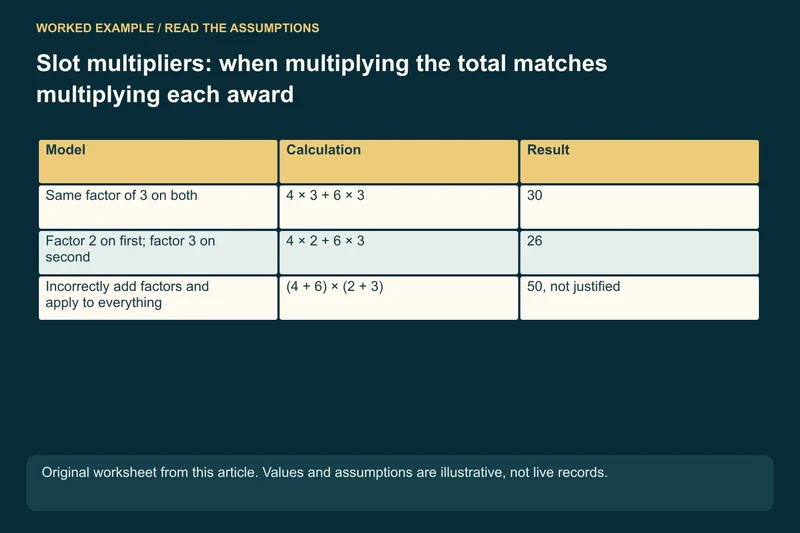
Assume two eligible base amounts, 4 and 6 units. Both receive the same factor of 3, with no cap or intermediate rounding. Multiplying separately gives 4 × 3 + 6 × 3 = 12 + 18 = 30. Adding first gives (4 + 6) × 3 = 30.
Different factors must stay with their amounts
| Model | Calculation | Result |
|---|---|---|
| Same factor of 3 on both | 4 × 3 + 6 × 3 | 30 |
| Factor 2 on first; factor 3 on second | 4 × 2 + 6 × 3 | 26 |
| Incorrectly add factors and apply to everything | (4 + 6) × (2 + 3) | 50, not justified |
In the second row, eight belongs to the first component and eighteen to the second. The incorrect third row applies both factors to both components, introducing extra terms that the assumed rule never authorized.
Eligibility can break the shortcut too
Suppose only the first amount receives a factor of three while the second remains unchanged. The result is 4 × 3 + 6 = 18, not 30. Merely seeing a 3× icon near the total does not establish that every component qualifies.
Read whether the factor belongs to a symbol, a particular win, a cascade, a feature or a final total. A cap or rounding step can also change which rearrangements preserve the final posted amount. The first example explicitly excludes those additional operations.
Annotate the components before simplifying
Write each base amount with its eligible multiplier beside it. Calculate those components under the documented order, then apply any separately stated cap or rounding rule. If the source does not say where a multiplier applies, leave the total unconfirmed rather than choosing the most favorable interpretation.
The calculation resolves an arithmetic question under stated assumptions. It does not establish symbol eligibility, a future outcome or the game’s actual configuration. Once the scope is known, the algebra can make a rule easier to read; it cannot supply a missing rule.
The lucky cola homepage brings together the site’s other reading topics.
Source-based editorial research and original examples. Sources checked 9 October 2026. No real-money play or account transaction was performed for this article.